Saturday, March 19, 2022

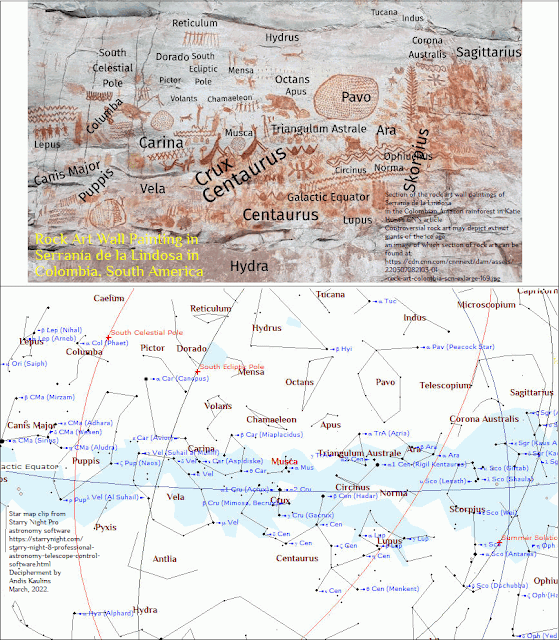
Serrania de la Lindosa Colombia South America Rock Art Wall Painting Section Deciphered as a Sky Map of the Southern Stars ca. 3000 B.C.

At CNN, Katie Hunt this month in her article
Controversial rock art may depict extinct giants of the ice age
featured a section of the rock art wall paintings of Serrania de la Lindosa
in the Colombian Amazon rainforest,
an image of which section of rock art can be found at:

https://cdn.cnn.com/cnnnext/dam/assets/220307082103-01-rock-art-colombia-scn-exlarge-169.jpg

We have deciphered that particular section of the wall painting below, finding it to be astronomical in nature and -- via the painted figures -- to depict the starry sky of the night as a sky map of the southern stars as seen from the wall painting Colombian location. 

Below is our decipherment, comparing the wall painting to what we allege are the comparable stars depicted, as shown by our clip of the comparable heavens using Starry Night Pro astronomy software (click on the image for a larger graphic);

In our opinion, the alleged age of the wall painting(s) by mainstream academia as being more than 12000 years old is extremely doubtful, expecially since the stars of Sagittarius seem to be clearly depicted as a horse-mounted rider, which is a much more recent rendering of the stars of that stellar constellation.

Based upon the wall painting's portrayal of the southern stars with Crux at the approximate horizontal middle of the painting, and taking into account the scope of the painting as running from approximately Canis Major on the left to Sagittarius and Scorpio on the right, which latter approximately mark the Autumn Equinox ca. 3000 B.C., we consider a date in that much later ambit to be far more likely.

Please note: the label for the stars of Ophiuchus was inadvertently pushed upward when adding text to the image. It should be lower to the right below Scorpius, where there is a large head profile. It will be corrected when we can get back to image work.

Tuesday, February 15, 2022

Zinātnes pētījumi un mēmu un memētikas loma: kas nosaka patieso patiesību? Science Research and the Role of Memes and Memetics : What Defines the Real Truth? Google Translate Latvian Translation of the English Language Original

Some years ago, Google Translate translations of text in blog postings were at best "moderately useful", but required substantial manual editing to obtain sufficient accuracy. Accordingly, it occurred to us recently that we should look anew at Google Translate translations of our materials for the two languages other than English that we ourselves speak fluently, German and Latvian.

The following translations (one here and one in the previous posting) are thus samples of Google Translate today, that we hope are representative for other languages as well. The translations are stunningly good, providing very useful results, but with a few exceptions, that in part surely depend on the writing clarity or unclarity of the original text.

One practical feature of Google Translate translations that we like is also that, when the reader hovers the mouse over a Google Translate translation of online material, the original text of the sentence underneath the mouse is shown in a text box. Try it out.

Below is the Google Translate Latvian translation, without substantial subsequent editing [minor edits in brackets], of Science Research and the Role of Memes and Memetics : What Defines the Real Truth? with that title translated by Google Translate into Latvian as Zinātnes pētījumi un mēmu un memētikas loma: kas nosaka patieso patiesību?

"Būdams Stanfordas Universitātes Juridiskās fakultātes absolvents, pašreizējais autors ar prieku lasīja žurnālā Scientific American pie Science Research Needs an Overhaul, ka Džons PA Joannidis pirms dažiem gadiem līdzdibināja jaunu centru Stanfordas Universitātē ar nosaukumu METRICS ("Meta-pētniecība". Inovāciju centrs Stanfordā ), lai risinātu dārgo problēmu, ka liela daļa galveno pētījumu tiek izšķiesti.

Ioannidis atsaucas uz vadošo medicīnas periodisko izdevumu The Lancet, kas apgalvo, ka šie "atkritumi" attiecas pat uz 85% medicīnas pētījumu, tā saukto "cieto" zinātni.

Cik slikti tad ir lietas mīkstajās zinātnēs, kur pierādījumu standarts, iespējams, ir zemāks nekā medicīniskajos pētījumos?

Ioannidis raksta, ka METRICS centrs:

"Mēģināsim izpētīt pētniecības praksi un to, kā to var optimizēt. Tajā tiks pārbaudīti labākie līdzekļi pētniecības protokolu un programmu izstrādei, lai nodrošinātu, ka rezultāti nav strupceļi, bet gan bruģē ceļu uz priekšu. Dariet to, izpētot, kādi ir labākie veidi, kā padarīt zinātnisko izpēti uzticamāku un efektīvāku .

Mēs ar entuziasmu atzinīgi vērtējam šo attīstību.

Mēs gadiem ilgi esam saskārušies ar lētticīgiem, neinformētiem un [pašpārliecinātiem] cilvēkiem gan zinātnē, gan ārpus tās, kas sludina galveno ideju un pētniecības metožu gandrīz nekļūdīgumu, un mums patiešām ir maz pacietības pret šādām muļķībām.

Paši mācīdami pētniecību universitātes līmenī, no pieredzes zinām, ka patiesība ir tieši pretēja tam, ko apgalvo zinātne...

un patiesība ir tāda, ka liela daļa no tā, kas tiek pētīts zinātnē, un tas ir salīdzinošais pārskats, kas publicēts šo pētījumu rezultātā, ir dārga laika izšķiešana un bieži vien virza zinātni nepareizā virzienā. Salīdzinošās pārskatīšanas process daļēji ir paredzēts, lai izpūstu valdošo iestāžu spalvas. "Patiesība" ir sekundāra lieta.

Viens no galvenajiem iemesliem šīm "zinātniskās izpētes" muļķībām, kā mēs esam vairākkārt rakstījuši, ir tas, ka zinātne pagātnē galvenokārt bija "balstīta uz autoritātēm", t.i., nevis "kas", bet gan "kurš" nosaka patiesību zinātnē, un šī novecojusi prakse ir radījusi milzīgas kļūdas. Pirms modernā laikmeta rītausmas "uz autoritātēm balstīta" zinātne bija nepieciešama, jo autoritātes bija galvenā zināšanu krātuve. Bet mūsdienu laikmetā tas ir ļoti mainījies.

Paskatieties uz COVID-19 koronavīrusa pandēmiju, kurā, neraugoties uz varonīgajiem centieniem, pēdējos divos gados ir bijušas grūtības iedibinātajām zinātnēm. "Zinātnei" vajadzēja būt labāk sagatavotai pandēmijai, nekā tā bija. Kāpēc tā nebija?

Zinātnes fokusa maiņa ir absolūti nepieciešama. Pagātnē dominējošie standarti, kad zinātnē valdīja tā sauktās "autoritātes", pašlaik mūsu digitālajā laikmetā bieži vien ir nevietā, kad ikviens, kas vēlas, tiešsaistē var meklēt gandrīz visu, ko vēlas. Pēdējā analīzē viena autoritāte šodien ir tikai vēl viens viedoklis. Lai nodrošinātu drošāku cilvēka nākotni, rītdienas zinātnei ir jābalstās uz zināmiem faktiem, nevis uz zināmām autoritātēm.

Mūsu digitālajā laikmetā galvenā prioritāte ir jāpiešķir "uz pierādījumiem balstītai izpētei".

No novecojušiem mēmiem ir lēnām jāatsakās.

Bet kas ir mēmes ?

Mēms ir termins, ko ieviesis Ričards Dokinss, Oksfordas universitātes Anglijā emeritētais profesors sabiedrības izpratnes jautājumos par zinātni.

Mēmas parasti tiek definētas kā "atkārtotas idejas, simboli vai prakse".

Mēs uzskatām, ka mēmi apraksta galvenās zinātnes stāvokli jebkurā laikā un izskaidro daudzas tās novirzes. Mēmas darbojas kā vīrusi (vai gēni).

Mēma Vikipēdijā ir definēta kā:

""[Ideja, uzvedība vai stils, kas kultūras ietvaros izplatās no cilvēka uz cilvēku. "Mēma darbojas kā kultūras ideju, simbolu vai prakses vienība, ko var pārnest no viena prāta uz otru, izmantojot rakstīšanu, runu, žestus, rituālus vai citas atdarināmas parādības ar atdarinātu tēmu. Koncepcijas atbalstītāji uzskata, ka mēmes ir kultūras analogi gēniem, jo ​​tie paši replikējas, mutē un reaģē uz selektīvu spiedienu... Vārdu mēms ieviesa britu evolūcijas biologs Ričards Dokinss [Richard Dawkins] ... kā jēdzienu diskusijām par evolūcijas principiem, izskaidrojot ideju izplatību un kultūras parādības. Mēmu piemēri, kas sniegti [izdevumā The Selfish Gene], ietvēra melodijas, īstās frāzes, modi un arku veidošanas tehnoloģiju."

Mūsuprāt, to, ko akadēmiskajā vidē parasti sauc par "domu skolu", precīzāk definē kā "mēmu", jo "domai" bieži nav nekā kopīga ar to. Drīzāk idejas, pareizi vai nepareizi, iesakņojas dažādās zinātnes disciplīnās un izplatās tā, it kā tām būtu sava dzīve. Tas pats attiecas uz politiku un reliģiju. Cilvēki tic lietām aiz ieraduma, nekam vairāk.

Patiesība nemaz nav problēma.

Drīzāk, kā rakstīts Wikipedia par Memetics

"Memētika ir garīgā satura teorija, kas balstīta uz analoģiju ar Darvina evolūciju... Piekritēji apraksta memetiku kā pieeju kultūras informācijas nodošanas evolūcijas modeļiem... Tāpat kā ģenētikā, īpaši Dokinsa [Dawkins] interpretācijā, mēma panākumi var būt tas ir saistīts ar tā ieguldījumu tās saimnieka efektivitātē."

Attiecīgi un pretēji priekšstatam, ka "patiesība" ir mērķis zinātnē vai citur, cilvēki tādējādi faktiski pieturas pie dotas idejas, domas skolas, kultūras prakses vai reliģijas , jo konkrētas mēmas piekritēji to uztver kā tādu, kas nodrošina tās turētājus tas mēms ar priekšrocībām. 

Šī būtiskā izpratne palīdz izskaidrot daudzas novirzes, kuras var atklāt zinātnē, jo, domājams, "racionālie" cilvēki stingri turas pie sen novecojušām idejām un veidiem, kā uz lietām skatīties, kas bieži ir pretrunā ar pieejamajiem pierādījumiem.

Mēs skatāmies uz pierādījumiem! 

Tas ir tas, kas nosaka mūsu darbu.

Wissenschaftsforschung und die Rolle von Memen und Memetik: Was definiert die wahre Wahrheit? A Stunningly Good Google Translate German Language Translation of Our Original English Language Posting

Some years ago, Google Translate translations of blog postings were at best "moderately useful", but required substantial manual editing to obtain sufficient accuracy. Accordingly, it occurred to us recently that we should look anew at Google Translate translations of blogpostings for the two languages other than English that we ourselves speak fluently, German and Latvian.

The following translations (one here and one in the posting following) are thus samples of Google Translate today, that we hope are representative for other languages as well. The translations are stunningly good, providing very useful results, but with a few exceptions, that in part surely depend on the writing clarity or unclarity of the original text.

One practical feature of Google Translate translations that we like is also that, when the reader hovers the mouse over a Google Translate translation of online material, the original text of the sentence underneath the mouse is shown in a text box. Try it out.

Below is the Google Translate German translation, without substantial subsequent editing [a few manual edits in brackets], of Science Research and the Role of Memes and Memetics : What Defines the Real Truth? with that title translated by Google Translate into German as Wissenschaftsforschung und die Rolle von Memen und Memetik: Was definiert die wahre Wahrheit? 

"Als Absolvent der juristischen Fakultät der Stanford University war der vorliegende Autor erfreut, im Scientific American at Science Research Needs an Overhaul zu lesen, dass John P.A. Ioannidis vor einigen Jahren ein neues Zentrum an der Stanford University namens METRICS ("the Meta-Research Innovation Center at Stanford") [etabliert hat], um das kostspielige Problem anzugehen, dass viel Mainstream-Forschung verschwendet wird.

Ioannidis zitiert die führende medizinische Zeitschrift The Lancet, die behauptet, dass diese „Verschwendung“ sogar für 85 % der medizinischen Forschung gilt, einer sogenannten „harten“ Wissenschaft.

Wie schlecht steht es dann in den Soft Sciences, wo der Beweisstandard wahrscheinlich niedriger ist als in der medizinischen Forschung?

Ioannidis schreibt, dass das METRICS-Zentrum:

„Ich werde versuchen, Forschungspraktiken zu untersuchen, und zu untersuchen wie diese optimiert werden können. Es wird die besten Mittel zur Gestaltung von Forschungsprotokollen und -agenden untersuchen, um sicherzustellen, dass die Ergebnisse keine Sackgassen sind, sondern vielmehr einen Weg nach vorne ebnen. Das Zentrum wird dies tun [...], indem Sie untersuchen, was die besten Möglichkeiten sind, um wissenschaftliche Untersuchungen zuverlässiger und effizienter zu gestalten."

Diese Entwicklung begrüßen wir ausdrücklich.

Wir sind seit Jahren mit leichtgläubigen, uninformierten und eigensinnigen Menschen innerhalb und außerhalb der Wissenschaft konfrontiert, die die nahezu Unfehlbarkeit von Mainstream-Ideen und Forschungsmethoden verkünden, und wir haben wirklich wenig Geduld für solche Torheiten.

Da wir selbst Forschung an der Universität gelehrt haben, wissen wir aus Erfahrung, dass genau das Gegenteil von dem gilt, was die Wissenschaft behauptet...

und wahr ist, dass viel von dem, was in der Wissenschaft erforscht wird, und das als Ergebnis dieser Forschung veröffentlichte Peer-Reviews eine kostspielige Zeitverschwendung sind und die Wissenschaft oft in die falsche Richtung führen. Der Peer-Review-Prozess existiert teilweise, um die Federn der amtierenden Behörden aufzuplustern. „Wahrheit“ ist Nebensache.

Ein Hauptgrund für diese Torheiten der „wissenschaftlichen Forschung“, wie wir immer wieder geschrieben haben, ist, dass die Wissenschaft in der Vergangenheit überwiegend „autoritätsbasiert“ war, dh nicht das „Was“, sondern das „Wer“. bestimmt die Wahrheit in der Wissenschaft, und diese veraltete Praxis hat zu massiven Fehlern geführt. Vor dem Anbruch der Moderne war eine „autoritätsbasierte“ Wissenschaft notwendig, da Autoritäten die wichtigsten Wissensspeicher waren. Aber das hat sich in der Neuzeit stark geändert.

Schauen Sie sich nur die COVID-19-Coronavirus-Pandemie an, bei der die etablierten Wissenschaften in den letzten zwei Jahren trotz heldenhafter Bemühungen ihre Schwierigkeiten hatten. Die „Wissenschaft“ hätte besser auf die Pandemie vorbereitet sein müssen, als sie es war. Warum nicht?

Eine Verschiebung des Fokus der Wissenschaft ist unbedingt erforderlich. Die vorherrschenden Standards der Vergangenheit, als sogenannte "Autoritäten" die Wissenschaft beherrschten, sind heute in unserem digitalen Zeitalter, in dem jeder, der will, fast alles, was er will, online nachschlagen kann, oft fehl am Platz. Letzten Endes ist eine Autorität heute nur noch eine Meinung. Um eine sicherere menschliche Zukunft zu gewährleisten, muss die Wissenschaft von morgen auf bekannten Tatsachen beruhen, nicht auf bekannten Autoritäten.

„Evidence-Based Research“ muss in unserem digitalen Zeitalter oberste Priorität haben.

Veraltete Memes müssen langsam aufgegeben werden.

Aber was sind Meme?

Meme ist ein Begriff, der von Richard Dawkins, emeritierter Professor für Public Understanding of Science an der Universität Oxford in England, geprägt wurde.

Meme werden allgemein als „ nachgebildete Ideen, Symbole oder Praktiken “ definiert.

Wir sehen Meme als Beschreibung des Standes der Mainstream-Wissenschaft zu einem bestimmten Zeitpunkt und als Erklärung für viele ihrer Abweichungen. Meme verhalten sich wie Viren (oder Gene).

Ein Meme wird bei Wikipedia wie folgt definiert:

„“ [Ein]e Idee, Verhaltensweise oder Stilrichtung, die sich innerhalb einer Kultur von Person zu Person verbreitet.Ein Meme fungiert als eine Einheit, um kulturelle Ideen, Symbole oder Praktiken zu transportieren, die durch Schreiben, Sprache, Gesten, Rituale oder andere nachahmbare Phänomene mit einem nachgeahmten Thema von einem Geist zum anderen übertragen werden können. Befürworter des Konzepts betrachten Meme als kulturelle Analoga zu Genen, da sie sich selbst replizieren, mutieren und auf Selektionsdruck reagieren ... Das Wort Meme wurde vom britischen Evolutionsbiologen Richard Dawkins geprägt ... als Konzept zur Diskussion evolutionärer Prinzipien zur Erklärung der Verbreitung von Ideen und kulturelle Phänomene. Beispiele für Meme, die [in The Selfish Gene] gegeben wurden, waren Melodien, Schlagworte, Mode und die Technologie des Baus von Bögen."

Was in der Wissenschaft normalerweise als „Schule des Denkens“ bezeichnet wird, ist unserer Ansicht nach genauer als „Mem“ definiert, da „Denken“ oft nichts damit zu tun hat. Vielmehr verankern sich Ideen, zu Recht oder zu Unrecht, in verschiedenen Wissenschaftsdisziplinen und verbreiten sich, als hätten sie ein Eigenleben. Dasselbe gilt für Politik und Religion. Die Leute glauben Dinge aus Gewohnheit, mehr nicht.

Die Wahrheit ist überhaupt nicht das Problem.

Vielmehr, wie bei Wikipedia über Memetics geschrieben:

Memetik ist eine Theorie des mentalen Inhalts, die auf einer Analogie zur darwinistischen Evolution basiert.... Befürworter beschreiben die Memetik als eine Annäherung an evolutionäre Modelle der kulturellen Informationsübertragung auf seinen Beitrag zur Leistungsfähigkeit seines Gastgebers zurückzuführen sein."

Dementsprechend und im Gegensatz zu der Vorstellung, dass „Wahrheit“ das Ziel in der Wissenschaft oder anderswo ist, halten Menschen tatsächlich an einer bestimmten Idee, Denkschule, kulturellen Praxis oder Religion fest, [weil die Anhänger eines bestimmten Mems es als Vorteil für die Inhaber dieses Mems wahrnehmen.]. Dieses grundlegende Verständnis hilft, viele Abweichungen zu erklären, die in der Wissenschaft entdeckt werden können, wobei [angeblich] "rationale" Menschen an längst überholten Ideen und Sichtweisen festhalten, oft im Widerspruch zu den verfügbaren Beweisen.

Wir schauen auf die beweiskräftigen Beweise!

Das macht unsere Arbeit aus."


Saturday, February 12, 2022

The Ancient Stargazing Origins of Timekeeping and Navigation : Celestial Chronology, Land Survey, and Mapmaking (Cartography) by Astronomy

Prehistoric Mankind's Primary Technologies Were Rooted in Astronomy and the Prevailing Economies Were Based on Land and Property, Mapped via the Stars

To understand the development of human civilization, it is important to recognize that mankind's first "scientific" technologies were arguably based on primitive "stargazing", i.e. what we modernly call "astronomy".

No less a thinker than Bertrand Russell wrote in Human Knowledge: Its Scope and Limits (Simon and Schuster, Clarion Books, New York, 1948) that:

"Astronomy is the oldest of the sciences, and the contemplation of the heavens, with their periodic regularities, gave men their first conceptions of natural law."

Furthermore, there is a direct connection to astronomy in terms of both land survey and land or sea navigation, as written at the Wikipedia under Surveying:

"The primary way of determining one's position on the earth's surface when no known positions are nearby is by astronomic observations. Observations to the sun, moon and stars could all be made using navigational techniques. Once the instrument's position and bearing to a star is determined, the bearing can be transferred to a reference point on the earth and which can then be used as a base for further observations. Survey-accurate astronomic positions were difficult to observe and calculate and so tended to be a base off which many other measurements were made. Since the advent of the GPS system, astronomic observations are rare as GPS allows positions to be determined adequately over most of the surface of the earth."

Since human survival has at all times depended on either ownership or control of actual physical territory on our planet Earth, that same astronomy served as the simplest way to map out that territory, with maps made to mirror the ever-present and ready-made sky map of the heavens, "as above, so below".

At our Megaliths.net website on megalithic cultures we have written:

"As observed by Alice Cunningham Fletcher (Alice C. Fletcher) in her 1902 publication in the American Anthropologist, there is ample evidence that some ancient cultures, e.g. the Pawnee in Nebraska, geographically located their villages according to patterns seen in stars of the heavens. Fletcher, A. C. (1902), Star Cult Among the Pawnee – A Preliminary Report, American Anthropologist, 4:730–736. doi:10.1525/aa.1902.4.4.02a00050."

To the importance of astronomy for ancient peoples we can add timekeeping, as written some time ago at Curious About Astronomy:

"In ancient times, the practical need for timekeeping and navigation was one of the primary reasons for the study of astronomy. The celestial origins of timekeeping and navigation are still evident."

In spite of the above observations, anthropologists and archaeologists worldwide generally proceed in their academic work as if the ancients knew more or less nothing of astronomy and, furthermore, placed little or no importance upon it for land survey, navigation, timekeeping and chronology, whereas the probative evidence that we have increasingly found presents exactly the opposite picture.

Astronomy DOMINATED the ancient world.

The Study of the History of Civilization : The Battle Against Monopolistically-Inclined Thinking

The Study of the History of Civilization: The Battle Against Monopolistically-Inclined Thinking
 
The "History of Civilization" is a concept which many people in academia misunderstand, thinking the study of the history of culture and technology to be the realm of specialized vested-interest historians or monopolist-like professions.
 
Alternatively seen, when we speak of the history of civilization, we must consider that the actual progress of mankind may have been substantially different than currently portrayed in over-creative, oft unsubstantiated documentaries on television or other media. Indeed, it is very likely that the "priests" of ancient cultures were, above all, less interested in pots and pottery, the realm of modern Archaeology, but were rather stargazers and land surveyors, comparable in their day to our astronomers and mapmakers.
 
As written by John Bedell at Bensozia in Aztec Surveying:
 
"The two things that drove mathematical progress in ancient civilizations were land surveying and astronomy."
 
"Civilization" thus may encompass a broader perspective than that presented to us by current science, and we need to grant such a possibility a greater audience.

We quote Winston S. Churchill, “Civilization,” Chancellor’s Address, University of Bristol, July 2, 1938, via Niall Ferguson in Civilization: The West and the Rest and Michael Kaplan at The New Jacksonian Blog, citing to Winston S. Churchill, Blood, Sweat, and Tears, Randolph S. Churchill, ed. (New York: G. P. Putnam’s Sons, 1941), pp. 45-46:
 
"There are few words which are used more loosely than the word “Civilization.” What does it mean?
 
It means a society based upon the opinion of civilians. It means that violence, the rule of warriors and despotic chiefs, the conditions of camps and warfare, of riot and tyranny, give place to parliaments where laws are made, and independent courts of justice in which over long periods those laws are maintained.
 
That is Civilization—and in its soil grow continually freedom, comfort and culture. When Civilization reigns, in any country, a wider and less harassed life is afforded to the masses of the people. The traditions of the past are cherished, and the inheritance bequeathed to us by former wise or valiant men becomes a rich estate to be enjoyed and used by all.
 
The central principle of Civilization is the subordination of the ruling authority to the settled customs of the people and to their will as expressed through the Constitution.
 
In this Island [Great Britain] we have today achieved in a high degree the blessings of Civilization. There is freedom: there is [the rule of] law; there is love of country; there is a great measure of good will between classes: there is a widening prosperity. There are unmeasured opportunities of correcting abuses and making further progress."
 
Despite those wonderful words of wisdom by Winston Churchill more than 80 years ago, we today live in an allegedly "modern" era where the cardinal virtues of Civilization are greatly under siege and where we can only view the future with a certain amount of trepidation. World news is still dominated daily by conflict and strife rather than by progress and peace. Science still suffers from great and colossal failings, despite heroic efforts, as the current pandemic teaches us all.

It may of course be argued that Civilization always wins in the end and moves onward or even forward, but it is always a battle against the forces of yesteryear and against various monopolistically inclined nations, groups, religions, organizations, and schools of thought, that always have -- and today continue -- to strive to bind mankind in the chains of blindered ignorance and superstition.
 
It is our duty, especially the best and most capable of us, to counter the selfish voices of despots and tyrants, small and large, whether in politics or academia.
 
We must lead positively into the future.
 
That is always the pioneer spirit behind our own work.
 

Scientific Research and the Role of Memes and Memetics : What Defines the Real Truth?

As a Stanford University Law School graduate, the present author was pleased to read in the Scientific American at Science Research Needs an Overhaul, that John P. A. Ioannidis some years ago co-founded a new center at Stanford University called METRICS ("the Meta-Research Innovation Center at Stanford") to deal with the costly problem that much mainstream research is wasted.

Ioannidis cites to leading medical periodical, The Lancet, which avers that this "waste" applies even to 85% of medical research, a so-called "hard" science.

How bad are things then in the soft sciences, where the standard of proof is likely lower than in medical research?

Ioannidis writes that the METRICS center:

"[W]ill seek to study research practices and how these can be optimized. It will examine the best means of designing research protocols and agendas to ensure that the results are not dead ends but rather that they pave a path forward. The center will do so by exploring what are the best ways to make scientific investigation more reliable and efficient."

We enthusiastically applaud this development.

We have been confronted for years by gullible, uninformed, and opinionated people in and out of science proclaiming the near infallibility of mainstream ideas and research methods and we really have little patience for such follies.

Having taught research ourselves at the university level, we know from experience that exactly the opposite of what is claimed by science is true...

and what is true is that much of what is researched in science and that is peer-review published as a result of that research is a costly waste of time and often leads science in the wrong directions. The peer-review process exists in part to fluff the feathers of the reigning authorities. "Truth" is a secondary matter.

One main reason for these follies of "scientific research", as we have written time and time again, is that science in the past has been predominantly "authority-based", i.e. it is not the "what" but the "who" that determines truth in science, and this outdated practice has led to massive errors. Before the dawn of the modern age, "authority-based" science was necessary since authorities were the key repositories of knowledge. But that has greatly changed in the modern era.

Just look at the COVID-19 coronavirus pandemic where the established sciences have had their difficulties the past two years, despite heroic efforts. "Science" should have been better prepared for the pandemic than it was. Why was it not?

A shift in the focus of science is absolutely necessary. The prevailing standards of the past, when so-called "authorities" ruled the roost in science, are currently often misplaced in our digital age when anyone who wishes can look up nearly anything they want online. In the last analysis, one authority today is just one more opinion. In order to insure a more secure human future, the science of tomorrow must be based upon known facts, not upon known authorities.

"Evidence-Based Research" must be given top priority in our digital age.

Outdated memes must be slowly abandoned.

But what are memes?

Meme is a term coined by Richard Dawkins, emeritus Professor for Public Understanding of Science at Oxford University in England.

Memes are defined generally as "replicated ideas, symbols or practices".

We view memes as describing the state of mainstream science at any given time and to explain many of its aberrations. Memes act like viruses (or genes).

A meme is defined at the Wikipedia as:

""[A]n idea, behavior, or style that spreads from person to person within a culture." A meme acts as a unit for carrying cultural ideas, symbols, or practices that can be transmitted from one mind to another through writing, speech, gestures, rituals, or other imitable phenomena with a mimicked theme. Supporters of the concept regard memes as cultural analogues to genes in that they self-replicate, mutate, and respond to selective pressures.... The word meme was coined by British evolutionary biologist Richard Dawkins ... as a concept for discussion of evolutionary principles in explaining the spread of ideas and cultural phenomena. Examples of memes given [in The Selfish Gene] included melodies, catch-phrases, fashion, and the technology of building arches."

In our view, what is normally called a "school of thought" in academia is more accurately defined as being a "meme", because "thought" often has nothing to do with it. Rather, ideas, rightly or wrongly, become entrenched in various disciplines of science and propagate themselves as if they had a life of their own. The same is true for politics and religion. People believe things out of habit, nothing more.

Truth is not at all the issue.

Rather, as written at Wikipedia about Memetics

"Memetics is a theory of mental content based on an analogy with Darwinian evolution.... Proponents describe memetics as an approach to evolutionary models of cultural information transfer.... As with genetics, particularly under a Dawkinsian interpretation, a meme's success may be due to its contribution to the effectiveness of its host."

Accordingly, and contrary to the notion that "truth" is the objective in science or elsewhere, people thus actually adhere to a given idea, school of thought, cultural practice or religion because the adherents of a particular meme perceive it as providing the holders of that meme with advantages. 

That essential understanding helps to explain many aberrations that can be discovered in science whereby presumably "rational" people hold fast to long-outdated ideas and ways of looking at things, often at odds with the available probative evidence.

We look to the probative evidence! 

That is what defines our work.


Thursday, December 02, 2021

Stajnia Cave Poland Mammoth Ivory Pendant Dorsal Side Decipherment Corroborated by "Opposite Astronomy Stars" on the Ventral Side Carvings

 No less a thinker than Bertrand Russell wrote in Human Knowledge: Its Scope and  Limits (Simon and Schuster, Clarion Books, New York, 1948) that:

"Astronomy is the oldest of the sciences, and the contemplation of the heavens,
with their periodic regularities, gave men their first conceptions of natural law."

 __________________________________________

Our previous decipherment of the so-called "dorsal side" carvings on the Stajnia Cave mammoth ivory pendant is corroborated by our "flipping" the pendant over and deciphering the carvings on the "ventral side" of that same pendant, as found pictured at https://www.nature.com/articles/s41598-021-01221-6/figures/1.

Critical, truly "scientific method"-oriented readers would arguably have examined this essential probative option on their own initiative -- right?

and we are sure you did....

Based upon our astronomical decipherment of the "dorsal side" of the pendant as representing midheaven stars ca. 7500 B.C., we would logically expect the "ventral side" to also represent stars, indeed, stars on the "other" side of Draco opposite that dorsal side, i.e. especially the stars of Cygnus, the swan.

And so it is, as shown by our decipherment image of the ventral side below:

The "Ventral Side" of the Stajnia Cave Mammoth Ivory Carved Pendant ca. 7500 B.C.
Our Decipherment of the Holes, Lines and Figures as Ancient Astronomy viz. "Stargazing"
Marking the Starry Night Stars of Midheaven
The underlying star map was created
via Starry Night Pro astronomy software
while the explanatory marks are by Andis Kaulins of Traben-Trarbach
(click on the graphic to obtain our larger, original decipherment image)


 We have been doing these kinds of decipherments for over 40 years now.

One day, some smart mainstream "scientists" will take notice ....

I myself turn 75 years of youth tomorrow.

I greet my few loyal "smart" followers herewith.

You belong to the "chosen few" who want to know

what our human ancestors were really like

and how our concepts of who we are in this universe

including the origin of our heaven-centered religions

developed through the ancient study of the stars.

The ancients sat around their campfires, 

looked up at the Milky Way,

and asked,

"Where -- in God's name -- are we?"

__________________________________________

No less a thinker than Bertrand Russell wrote in Human Knowledge: Its Scope and  Limits (Simon and Schuster, Clarion Books, New York, 1948) that:

"Astronomy is the oldest of the sciences, and the contemplation of the heavens,
with their periodic regularities, gave men their first conceptions of natural law."

__________________________________________


Wednesday, December 01, 2021

Stajnia Cave Mammoth Ivory Pendant Carvings Deciphered by Andis Kaulins as Portraying the Midheaven Stars of the Starry Sky ca. 7500 B.C.

An article titled "A 41,500 year-old decorated ivory pendant from Stajnia Cave (Poland)" by Talamo, S., Urbanowski, M., Picin, A. et al. was presented at Nature Magazine's Scientific Reports, Sci Rep 11, 22078 (2021), https://doi.org/10.1038/s41598-021-01221-6. For the location of Stajnia Cave, please see the map at https://www.nature.com/articles/s41598-020-71504-x.

That same pendant has now subsequently appeared in Nature Magazine's News, November 29, 2021, under the headline "Is this mammoth-ivory pendant Eurasia’s oldest surviving jewellery?", sub-headlined as "Radiocarbon dating suggests 41,500-year-old carved tusk fragment could be the region’s earliest known example of jewellery decorated by humans."

We do not analyze here the dubious alternative interpretative explanations offered by the archaeological mainstream community for the significance of the ivory carvings on the mammoth pendant, nor do we go into the radiocarbon dating of the mammoth ivory, whose carvings can of course be of a much later origin.

There is in our opinion a clear and inescapable interpretation of the mammoth ivory carvings possible -- our decipherment -- as portraying the midheaven of stars of the starry night sky, which carvings we thus date to ca. 7500 B.C.

Our date of ca. 7500 B.C. was selected because of our decipherment-required position of the North Celestial Pole in that era. The position of the North Celestial Pole changes slowly but continuously over a period of ca. 25920 years due to axial precession, so that a date of ca. 33420 B.C. would be theoretically, but not technologically, possible, when the North Celestial Pole was at this same location.

However, we regard an earlier provenance of the carvings to be impossible, since the sophistication of the stargazing astronomy represented here would fit well into post-Pleistocene Ice-Age technology, but not into previous technology eras.

To produce our decipherment, we created an independent, unaffiliated drawing of the most prominent lines on the pendant, as based on our analysis of a photo of the pendant in question as credited to Antonino Vazzana/BONES Lab see https://www.nature.com/articles/d41586-021-03534-y.

The Stajnia Cave Mammoth Ivory Carved Pendant ca. 7500 B.C.
Our Decipherment of the Holes, Lines and Figures as Ancient Astronomy viz. "Stargazing"
Marking the Starry Night Stars of Midheaven

The underlying star map was created
via Starry Night Pro astronomy software
while the explanatory marks are by Andis Kaulins of Traben-Trarbach
(click on the graphic to obtain our larger, original decipherment image)


The red dashed lines overlapping the Starry Night Pro star map clip underneath have been added by Andis Kaulins and are meant to correspond to the round marks found carved on the Stajnia Cave mammoth ivory pendant. The blue circular objects overlappingly drawn in the star map by Andis Kaulins identify groups of stars which correspond to figures viz. markings that we allege to be found carved on the pendant, but those identifications are speculative as such lines on the pendant are very weak, if they exist at all, and are difficult to prove. The dark grey lines added by Andis Kaulins mark areas with few stars in the sky that correspond to dark areas on the pendant. The light grey lines added by Andis Kaulins mark the outer perimeter of the pendant in the stars.

Late addition: please note that the lowest figure on this side of the pendant, called the "dorsal side", marks the stars of Ursa Minor. Our decipherment of the "ventral side" as corroborating ancient astronomy follows in the next posting.


Sunday, October 31, 2021

Star Constellations of Ancient Egypt and the Astronomical Decipherment of the Northern Arabia Neolithic Camel Site

The Celestial River: Identifying the Ancient Egyptian Constellations, Sino-Platonic Papers, 253 (December 2014), Victor H. Mair, Editor, Dept. of East Asian Languages & Civilizations, Univ. of Pennsylvania, Philadelphia, PA, 19104-6305 USA, vmair@sas.upenn.edu, www.sino-platonic.org

authored by Alessandro Berio

-- as posted by Magdi Saleh at Academia.edu --

presents astronomical analysis that bears significantly upon our recent postings about the Northern Arabia "Camel Site", which we have -- allegedly --- deciphered as Neolithic astronomy, and which, in our opinion maps the stars of the starry night ca. 4800 B.C.

... with "the legs of the Camel" standing on the Celestial Equator at the Vernal Equinox, the left side of the camel marking the Summer Solstice and the right side of the camel marking the Winter Solstice, with the stars in the heavens being marked by carved figures and cupules (holes viz. indentations carved into stone).

We thank here the website Academia.edu for alerting us to the respective link to the article by Berio as found at https://www.academia.edu/23910738/The_Celestial_River_Identifying_the_Ancient_Egyptian_Constellations.

We are sympathetic to Berio's approach, but our present posting does not engage in individual analysis -- pro or contra -- of the ancient Egyptian Constellations identified in Berio's publication or the system of rising and setting stars that is said there to explain some of the hieroglyphs (viz. "emblems") of the nomes. Each reader can evaluate the material on their own starting at the above link.

Given our own knowledge and understanding of the use of rising and setting stars in ancient astronomy and given our own writings about MUL.APIN : Decipherment as Astronomy (see there for a start), we find that Berio has definitely produced a remarkable and highly interesting analysis which deserves our attention. See in this regard also our year 2004 postings on the astronomical and hermetic significance ("as above, so below") of the nomes of Egypt at:

What interests us here as a general matter is the star placement comparison of:

THE NEOLITHIC CAMEL SITE of NORTHERN ARABIA
ASTRONOMICAL DECIPHERMENT as ca. 4800 B.C. by ANDIS KAULINS


  • with Berio's Classical star map with Ptolemaic constellations compared to nome emblems overlaid on a map of the sky circa 3100 BC as seen from Memphis (30.57° N).
  • Classical Star Map with Ptolemaic Stellar Constellations and
    Nome Emblems Overlaid on a Sky Map ca. 3100 B.C.
    according to Alessandro Berio


    Our decipherment placement of starry night stars at the Camel Site finds numerous comparables in depiction on the above map of Ancient Egyptian stellar constellations as represented by Berio, though we do not agree on all of them, but that latter is not the issue here. Some DO agree, and that is what is important.

    Moreover, in terms of researching the importance of the Ancient Egyptian nomes as hermetic astronomy ("as above, so below"), perhaps marking rising and setting stars, take a look at our Camel Site decipherment finding that the dog, Anubis, is there at the position of the stars of Libra, which stellar location was a mystery to us initially, but which makes sense as a placement given the rising and setting star analysis for nome emblems by Berio, who writes as follows:

    "Sirius, the brightest star of Canis Major, was identified with the goddess Isis-Sothis, the Egyptian mother goddess. Diodorus explains that the ritual procession of the Festival of Isis was led by dogs, an association illustrated in a passage by Diodorus:

    On the stele of Isis it runs: “I am Isis, the queen of every land… I am she who riseth in the star that is in the Constellation of the Dog; by me was the city of Bubastus built.”

    The capital of the 18th nome of Upper Egypt ... was a place for the worship of Anubis, the dog-headed god, as the city was known as the “House of Anubis.” This nome corresponded to the time at which Canis Major’s star, Aludra, known as the “Virgins” to early Arab astronomers, was in its lower culmination, and Spica, the brightest star in Virgo, the virgin, was setting ...."

    It would seem, therefore, as a possibility, that the astronomy deciphered by us at the Neolithic Camel Site in Northern Arabia may be a precursor to the hermetic ("as above, so below") astronomy of the later Pharaohs of Ancient Egypt. 

    Obviously, the historical ramifications are substantial if the chronological dates in question -- starting with around 4800 B.C. -- are correct. And it also may raise the question of whether the creators of the Camel Site were indigenous inhabitants, or more distant nomads, or, indeed, especially because of the "megalithic" style of portrayal, were perhaps even more distant ancient surveyors, stargazers and/or navigators from elsewhere who first carved the astronomical figures in Northern Arabia.

    See in this wider connection our previous postings at:

    Wednesday, October 20, 2021

    Neolithic Northern Arabia Archaeoastronomical "Camel Site Decipherment Image" by Andis Kaulins Updated October 20, 2021

    Please note:

    The graphic Neolithic Northern Arabia Archaeoastronomical
    "Camel Site Decipherment Image" by Andis Kaulins
    presented in full in previous postings
    was updated on October 20, 2021 with some additions
    and improved color management of the figures,
    thus, for example, retaining a clear view of the legs of the camel.

    See the updated decipherment.


    Tuesday, October 19, 2021

    The Rock Art "Camel Site" in Arabia Deciphered as a Neolithic Representation of the Night Starry Sky by Figures ca. 4800 B.C.

    The Neolithic Rock Art "Camel Site" in Arabia Deciphered as Astronomy

    Please note: the graphic below
    was updated with some corrected star placements on October 20, 2021.

    Our Interactive Lesson #6 consists of our independent archaeoastronomical decipherment of the Rock Art so-called "Camel Site" located in Northern Arabia.

    This is the last interactive lesson in this series of postings, which we will follow up with some explanatory postings about various aspects of our decipherment below. 

    There are many unexpected surprises, especially for the era in question.

    Look at the decipherment graphic and draw your own conclusions.

    The Neolithic Rock Art "Camel Site" in Arabia:
    Interactive Lesson #6: Our Full Decipherment Image
    The Camel Site Portrays the Night Starry Sky
    ca. 4800 B.C. by Figures

    Click on the graphic below
    to obtain a larger, more readable image! 

    Please note that the graphic below
    was updated on October 20, 2021
    with improved color management of the figures
    and some corrected star placements


    Thursday, October 14, 2021

    The Neolithic Camel Site in Northern Arabia: Interactive Lesson #5: Auriga to the Left of Perseus and Carved Figures and Cupule Stars to the Right of Perseus

    The Neolithic Rock Art Camel Site in Arabia: Interactive Lesson #5: Auriga to the Left of Perseus and Carved Figures and Cupule Stars to the Right of Perseus

    The stars of Auriga at the Camel Site are represented by the head of a goatherd with typical headdress, plus the head (and fleece ?) of an adult goat with several goat kids. This corroborates the correctness of our previous placement of the stars of Perseus to the right of Auriga. The fleece viz. the "wool" of Auriga is carved in the rock in an appropriate "ruffled" texture way. The adult goat appears to have several goat kids behind it, plus maybe a goat dog ("sheepdog") to the back left. 

    The Neolithic Rock Art Camel Site in Arabia: Interactive Lesson #5
    Auriga the Goatherd is to the Left of Perseus
    Auriga includes a Goat head profile and several goat kids, plus goatherd dog.
    Cepheus, Cassiopeia, and Andromeda are to the Right of Perseus

    Please click on the graphic below to obtain a larger image.

    The figures to the right of Perseus are more difficult to assign with certainty, as they are very strongly characterized by the megalithic style of carving figures within figures within figures, which makes identification more speculative.

    We think those figures mark stars of what we moderns identify as the stellar constellations of Cepheus, Cassiopeia, wife of Cepheus, and their daughter Andromeda -- a heavenly family as it were -- whose origins, e.g., in Egypt, and even by mainstream archaeology, reach back far and at least into predynastic ("pre-Pharaoh") times. Just how old these heavenly figures assigned to groups of stars in the starry sky actually are -- nobody really knows, but it is clear from the Neolithic Rock Art Camel Site in Arabia that they are much older then previously thought by the mainstream of researchers.

    Just as an aside:
    We think the term Auriga originally meant "sheep, lamb" as arguably in what we see as a hypothetical proto-Indo-European root found e.g. in Latvian jēr- jēruk- (=*aurig-) meaning "of (a) lamb".

    The Latin meaning of "charioteer" may arise out of a linguistic confusion of "auriga" with e.g. the root of a word like "quadriga" and similar terms, which at their root have the meaning "yoke" in proto-Indo-European, as in archaic Latvian "jūgs, jūg-".

    The next posting in this series is Interactive Lesson #6. 

    Can you already find the stars portrayed on the left side of the carved rock but not yet identified?


    Sunday, October 10, 2021

    The Camel Site in Arabia: Interactive Lesson #4: More Figures at Perseus and the Stars of the Leg to the Left

    The Camel Site in Arabia: Interactive Lesson #4: More Figures at Perseus and the Stars of the Leg to the Left

    In the image below we see the figure of Perseus, and an additional coiled (?) figure below it -- above the Hyena -- that emerges when we look at the stone-carved figures in detail.

    THE STARS OF PERSEUS (IN FULL) AT THE CAMEL SITE
    AND THE STARS OF THE CAMEL'S LEG TO ITS LEFT

    Click on the image to view a larger image version.

    Perseus appears to wear a military-type (?) plumed hat and we can only ask ourselves if the figure below him is Medusa or a serpent-type figure, for this is very speculative and not perfectly clear. Such a hat is not likely to date back to 4800 B.C. Perhaps such figures were added later in time, in another era, by ancients who knew which stars the carved Camel Site represented in the sky.

    Posting #5 of this decipherment series on the Camel Site of Northern Arabia follows, deciphering figures and stars to the right of Perseus, including the camel's leg to the right.

    Saturday, October 09, 2021

    The Camel Site in Arabia: Interactive Lesson #3: Where are the Stars of Perseus Marked by a Figure and Cupmarks? And Where is the Hyena?

    Once one recognizes that the large camel at the Camel Site marks the Celestial Equator, the Celestial Meridian and the Celestial North Pole by its features...

    and if we also have a good idea of the date of the human stone carving work...

    then the general positions of the stars at the Camel Site are inevitable...

    because their position is thereby determined by the major astronomical parameters.

    The stars can not be elsewhere, and we can thus not place them subjectively,

    although it is also true, however, that individual stars may be difficult to identify with perfect certainty. Everything is not always as easy as it appears.

    We started out with the figure and cupmarks of the stars of Perseus because their placement at the Camel Site is eminently obvious. Just look at the Starry Night Pro star map below, a stellar map which we have already posted previously. Find Perseus on that star map and you will then know where to look for Perseus at the Camel Site stone relief.

    THE STARRY SKY SECTION REPRESENTED AT THE CAMEL SITE
    MARKS STARS AT AND ABOVE THE CELESTIAL EQUATOR ca. 4800 B.C.
    Image clip 2021 A.D. by Andis Kaulins via Starry Night Pro astronomy software

     Click on the image to view a larger image version.
    (image updated on 7 October 2021)

    As one can see from above, Perseus is to the far right of the Vernal Equinox on that 4800 B.C. star map and that is where we expect to find Perseus represented on the large camel at the Camel Site ... and so it is, as seen below.

    THE CAMEL SITE MARKS THE STARS OF PERSEUS
    TO THE RIGHT OF THE VERNAL EQUINOX in 4800 B.C.
    AND ITS LOWER STARS SHOW A HYENA NIPPING AT THE HEEL OF THE CAMEL
    We have previously written that:
    "Significant for our discussion of ancient celestial poles
    is the fact that the Arabic Bedouins in Egypt, instead of a dragon,
    saw a circle of camels at heaven’s center that was being attacked by hyenas.
    "
    https://megalithicworld.wordpress.com/2007/11/14/horusfalconcultasastronomy/

     Click on the image to view a larger image version.


    The arguably older representation is the tapered relief-carved figure of Perseus.
    The arguably younger presentation consists of cupmarks
    (carved holes in stone) of the brighter stars of Perseus,
    as still used in modern astronomy to portray the figure of Perseus in the sky.

    The hyena at the heel of the camel -- supporting ancient heavenly depiction --
    is proof of the correctness of our decipherment of "The Camel Site" in Arabia.

     Lesson #4 is forthcoming in the next posting.


    Thursday, October 07, 2021

    The Camel Site: Interactive Lesson #2: What is the Camel Carrying? The Camel Carries the Starry Sky

    The Neolithic Rock Art Camel Site in Northern Arabia as Astronomy:
    Interactive Lesson #2:
    What is the Camel Carrying?
    The camel carries the starry sky.

    The mid-center Celestial Meridian as the prominent left foreleg of the camel and the top of the camel's hump at the location of the North Celestial Pole indicate that the camel carries the stars in the sky, i.e. the vault of heaven.

    Arab sources of antiquity place the camel at a position near the North Celestial Pole. Citing to Richard Hinckley's Star Names: Their Lore and Meaning (Dover edition, 1963)We have previously written that:

    "Significant for our discussion of ancient celestial poles is the fact that the Arabic Bedouins in Egypt, instead of a dragon, saw a circle of camels at heaven’s center that was being attacked by hyenas."
    See:
    https://megalithicworld.wordpress.com/2007/11/14/horusfalconcultasastronomy/

    Before we present our decipherments, the reader may try to identify stars represented at the Camel Site by carved figures and holes carved in stone to represent bright stars or groups of bright stars. Good luck!

    Groups of stars can be represented by figures, as we still do in modernity by the stellar constellations.

    But stars can also be represented individually by "cupmarks" (cupules, holes carved in stone to represent stars).

    Usually -- the larger the hole, the brighter the magnitude of the star.

    Please note:

    The carved figures at the Camel Site are likely to be older than the identifiable cupmarks, which appear to be younger, because they cover less space than the corresponding figures. We see this at the representation of the stars of Perseus, which we add to our decipherment image in the next posting.

    This same phenomenon is found at sites such as Lascaux in France -- but, to our knowledge, is something not recognized by mainstream archaeologists -- where cave paintings cover rocks that were already previously carved to mark the same stars as the later paintings.

    People often see what they want to see or things easy to see ... and miss the rest. No less an observer than Albert Einstein said that he had little patience with scientists who drilled only where the drilling is easy.


    The Camel Site in Northern Arabia ca. 5000 BC: Neolithic Rock Art as Astronomy: Interactive Lesson #1: Where does the Camel Stand? It Stands on the Celestial Equator

    The Neolithic Rock Art Camel Site in Northern Arabia as Astronomy:
    Interactive Lesson #1:
    Where does the Camel Stand?
    It Stands on the Celestial Equator

    Our interactive decipherment begins with a clip of the section of sky that we regard to be represented by carved figures and cupmarks at "The Camel Site"
    -- figures and holes carved in stone to mark bright stars viz. star groups.

    The starry sky corresponding to the stars represented by the Camel Site is found
    in the image below -- applying to stars ca. at or above the Celestial Equator on which the camel stands ... carrying the heavens. Our image clip from Starry Night Pro astronomy software is the year 4800 B.C., close to the dates of ca. 5600 to 5200 BCE estimated by archaeologists for human inhabitation of the site.

    THE STARRY SKY SECTION REPRESENTED AT THE CAMEL SITE
    MARKS STARS AT AND ABOVE THE CELESTIAL EQUATOR ca. 4800 B.C.
    Image clip 2021 A.D. by Andis Kaulins via Starry Night Pro astronomy software

     Click on the image to view a larger image version.
    (image updated on 7 October 2021)

     
    Camel Site Stars Arabia 24 Jan  4800 BC.png

    The Celestial Equator in the star map above is the red nearly horizontal line running through the Vernal Equinox. The Celestial Equator at the Camel Site is the line drawn below -- and identified by us -- upon which the camel stands:

    THE CAMEL SITE CELESTIAL EQUATOR ON WHICH THE CAMEL STANDS

    Click on the image to view a larger image version.

    That line provides the foundation for the astronomical decipherment. Once such an important astronomical parameter is correctly identified, the rest follows. 

    See if you can now identify the stars represented at the Camel Site without referring to our decipherment. You have the star map above.

    This posting begins a series of experimental interactive presentations of our recent, independent, and unaffiliated archaeoastronomical decipherment of the so-called archaeological "Camel Site" in Northern Arabia...

    as that site is described by the following authors
    Maria Guagnin, Guillaume Charloux, Abdullah M. AlSharekh, Rémy Crassard, Yamandú H. Hilbert, Meinrat O. Andreae, Abdullah AlAmri, Frank Preusser, Fulbert Dubois, Franck Burgos, Pascal Flohr, Pascal Mora, Ahmad AlQaeed, and Yasser AlAli...

    in their article
    Life-sized Neolithic camel sculptures in Arabia: A scientific assessment of the craftsmanship and age of the Camel Site reliefs
    , Journal of Archaeological Science: Reports, 2021, 103165, ISSN 2352-409X
    https://doi.org/10.1016/j.jasrep.2021.103165
    as found published online at...

    https://www.sciencedirect.com/science/article/pii/S2352409X21003771
    .

    More Camel Site photos are also published at Artnet.com in Thousands of Years Before the Pyramids, Neolithic Peoples Were Carving Camels into Saudi Arabia’s Rocky Desert, an article by Sarah Cascone online at :

    https://news.artnet.com/art-world/ancient-saudi-arabian-camel-carvings-are-actually-older-than-stonehenge-and-the-pyramids-of-giza-2012754

    In order to avoid copyright image issues -- we make our own drawings for use in the course of our decipherment and refer readers to original photographs in the above cited sources for review. We have no affiliation with any of the above.

    We now look at the Celestial Meridian and Celestial North Pole in Lesson #2, i.e. the next posting. The question is: What is the Camel Carrying?

    Monday, March 29, 2021

    The Hebrew Calendar Starts Autumn 3761 B.C. Is it Because the Autumn Equinox Location in the Stars Was Virtually at the Center of Our Galaxy in that Era?

    We came to the conclusion some years ago that the main focus of Stonehenge alignments (our independent discovery) is the galactic center of our Milky Way Galaxy (the "Galactic Centre"). 

    Megalithic culture seems to mirror an ancient belief of mankind that the galactic center of our galaxy was the origin of souls, a location in the stars to which human souls were correspondingly also believed to return upon worldly passage.

    We examined the origin of the Hebrew Calendar and found it to be similar.

    What reason did the Hebrew forefathers possibly have for starting their calendar in Autumn, 3761 BC?

    People did not likely say, "Oh, let's start a calendar today!" just any day. They surely had a very strong TIMELY reason for their choice.

    We were then not surprised to find that the Autumn start of the Hebrew Calendar in Autumn 3761 B.C. corresponds to the location of the Autumn Equinox in that era at the Galactic Centre of our Milky Way of stars.

    At TimeAndDate.com, Konstantin Bikos writes at The Jewish Calendar that:

    "12th-century Jewish philosopher Maimonides established 3761 B.C. as the biblical Date of Creation". [link added by us]

    That post facto later date creationist-type explanation arguably reflects ancient astronomical religious knowledge, myth or legend as conceivably passed down over the generations by astronomically calendric-savvy Jewish diaspora priests.

    We present below an image of the stellar center of our Milky Way galaxy, via an underlying clipped star map made by us via Starry Night Pro astronomy software, to which the present author of this posting, Andis Kaulins, the LawPundit, has added a circle to represent the Galactic Centre with arrows added to show the "striking" lines of stars pointing to the center of our Milky Way Galaxy.

    There is of course no way to fully "prove" that this theory of the origin of the Jewish Calendar in 3761 B.C. is correct beyond doubt, but we think it adds some new astronomical and calendric sense to the origin of mankind's calendar time-keeping by the positions of the "Sun, Moon and Stars".

    Note that the position of the Center of our Milky Way Galaxy must have been known by the ancient stargazers already in that era. These ancient "astronomers" likely formed the "purposeful" if also subjective figures of the nearest surrounding stellar (star) constellations viz. asterisms or similar groupings of stars to correspond to their astronomical knowledge of the location of the Galactic Centre.

    These ancient "druids", for lack of a better term, also surely drew prominent "pointing" lines of stars using bright magnitude stars in their subjectively drawn figures, precise intended lines that point to the Galactic Centre, specifically:

    • the tip of the arrow of Sagittarius points to the Galactic Centre
    • the stinger of Scorpio points to the Galactic Centre, and
    • the lowered (we think, then serpent head of Ophiuchus), or one could view it as the bottom head of the "staff" around which the serpent of Ophiuchus perhaps twined, also points to the Galactic Centre. One can be of different minds about which precise stars the ancients actually intended, but the posited scheme is clear.

     "Striking" Stars at the Milky Way Galactic Centre

    Some might suggest that this confluence is chance only, but such a pure coincidence would be unlikely given the "striking" nature of the figures used.

    The three constellations Ophiuchus, Scorpio and Sagittarius not only "surround" the Galactic Centre but are specifically characterized and marked by what might be called "striking" directional lines of stars aimed at the Galactic Centre. In our view, such an unusual merging of purpose was INTENDED by the ancients.

    As one can read in our other postings, it was this galactic center that was the focus of attention of major later megalithic sites, e.g. Stonehenge in particular.


    Most Popular Posts of All Time

    Sky Earth Native America


    Sky Earth Native America 1:
    American Indian Rock Art Petroglyphs Pictographs
    Cave Paintings Earthworks & Mounds as Land Survey & Astronomy
    ,
    Volume 1, Edition 2, 266 pages, by Andis Kaulins.

  • Sky Earth Native America 2:
    American Indian Rock Art Petroglyphs Pictographs
    Cave Paintings Earthworks & Mounds as Land Survey & Astronomy
    ,
    Volume 2, Edition 2, 262 pages, by Andis Kaulins.

  • Both volumes have the same cover except for the labels "Volume 1" viz. "Volume 2".
    The image on the cover was created using public domain space photos of Earth from NASA.

    -----

    Both book volumes contain the following basic book description:
    "Alice Cunningham Fletcher observed in her 1902 publication in the American Anthropologist
    that there is ample evidence that some ancient cultures in Native America, e.g. the Pawnee in Nebraska,
    geographically located their villages according to patterns seen in stars of the heavens.
    See Alice C. Fletcher, Star Cult Among the Pawnee--A Preliminary Report,
    American Anthropologist, 4, 730-736, 1902.
    Ralph N. Buckstaff wrote:
    "These Indians recognized the constellations as we do, also the important stars,
    drawing them according to their magnitude.
    The groups were placed with a great deal of thought and care and show long study.
    ... They were keen observers....
    The Pawnee Indians must have had a knowledge of astronomy comparable to that of the early white men."
    See Ralph N. Buckstaff, Stars and Constellations of a Pawnee Sky Map,
    American Anthropologist, Vol. 29, Nr. 2, April-June 1927, pp. 279-285, 1927.
    In our book, we take these observations one level further
    and show that megalithic sites and petroglyphic rock carving and pictographic rock art in Native America,
    together with mounds and earthworks, were made to represent territorial geographic landmarks
    placed according to the stars of the sky using the ready map of the starry sky
    in the hermetic tradition, "as above, so below".
    That mirror image of the heavens on terrestrial land is the "Sky Earth" of Native America,
    whose "rock stars" are the real stars of the heavens, "immortalized" by rock art petroglyphs, pictographs,
    cave paintings, earthworks and mounds of various kinds (stone, earth, shells) on our Earth.
    These landmarks were placed systematically in North America, Central America (Meso-America) and South America
    and can to a large degree be reconstructed as the Sky Earth of Native America."


    Our Blogs and Websites

    • 99 is not 100 • Aabecis • AK Photo Blog • Ancient Egypt Weblog • Ancient World Blog • AndisKaulins.com • Andis Kaulins Blog • Archaeology Travel Photos (Flickr) • Archaeology Websearch • Archaeo Pundit • Arts Pundit • Astrology and Birth • Baltic Coachman • Biotechnology Pundit • Book Pundit • Chronology of the Ancient World • Easter Island Script • Echolat • edu.edu • Einstein’s Voice • Etruscan Bronze Liver of Piacenza • EU Pundit • Gadget Pundit • Garden Pundit • Golf Pundit • Gourmet Pundit • Hand Proof • House Pundit • Human Migrations • Idea Pundit • Illyrian Language • Indus Valley Script • Infinity One : The Secret of the First Disk (the game) • Isandis (blogspot) • Journal Pundit • Kaulins Genealogy Blog • Kaulinsium • Latvian Blog • LawPundit.com • LawPundit (blog I) • Law Pundit (blog II) • LexiLine.com • Lexiline Journal • LexiLine (ProBoards) • Library Pundit • Lingwhizt • Literary Pundit • Magnifichess • Make it Music • Maps and Cartography • Megalithic World • Megaliths • Megaliths.net • Minoan Culture • Mutatis Mutandis • Nanotech Pundit • Nostratic Languages • Phaistos Disc • Pharaonic Hieroglyphs • Photo Blog of the World • Prehistoric Art Pundit • Private Wealth Blog • PunditMania • Quanticalian • Quick to Travel • Quill Pundit • Road Pundit • Sport Pundit • Star Pundit • • Stars Stones and Scholars (blog) • Stars Stones and Scholars (book) • Stonehenge Pundit • The Enchanted Glass • UbiquitousPundit • WatchPundit • Wine Pundit • Word Pundit •