Saturday, May 28, 2016

The Bruniquel Cave "Ring" Construction is a Sky Map of the Heavens and By No Means 176000 Years Old, and Thus Likely Not Constructed by Neanderthals

The world is greatly indebted to Jacques Jaubert, Sophie Verheyden, and the other listed authors and unlisted assistants for their just-published Letter in Nature magazine titled Early Neanderthal constructions deep in Bruniquel Cave in southwestern France, 25 May 2016, doi:10.1038/nature18291. Thank you for this new, wonderful site out of the pages of human history!

However, there are serious problems with the interpretation of the site, including its "ceremonial significance", its chronological dating and its assignment to the Neanderthals. We offer some new solutions below based upon our decipherment of the site. Our purpose is not to criticize, but to add new understanding. Thank you.

That Letter contains the following Abstract which we quote for background:
"Very little is known about Neanderthal cultures1, particularly early ones. Other than lithic implements and exceptional bone tools2, very few artefacts have been preserved. While those that do remain include red and black pigments3 and burial sites4, these indications of modernity are extremely sparse and few have been precisely dated, thus greatly limiting our knowledge of these predecessors of modern humans5. Here we report the dating of annular constructions made of broken stalagmites found deep in Bruniquel Cave in southwest France. The regular geometry of the stalagmite circles, the arrangement of broken stalagmites and several traces of fire demonstrate the anthropogenic origin of these constructions. Uranium-series dating of stalagmite regrowths on the structures and on burnt bone, combined with the dating of stalagmite tips in the structures, give a reliable and replicated age of 176.5 thousand years (±2.1 thousand years), making these edifices among the oldest known well-dated constructions made by humans. Their presence at 336 metres from the entrance of the cave indicates that humans from this period had already mastered the underground environment, which can be considered a major step in human modernity."
The mainstream scholars do not know what the Bruniquel Cave "Ring" Construction signifies beyond some inkling that the site may have had some "ceremonial significance". That lack of knowledge is not surprising. Archaeologists are not astronomers. Astronomers are not archaeologists. This has left an expertise vacuum in scholarly study of the history of humankind. Even archaeoastronomy concentrates too much on lunar and solar alignments and leaves out the stars -- which for prehistoric peoples were more important.

We are pleased to report here that we have deciphered the stalagmite circle constructions at Bruniquel Cave as astronomy -- specifically, as a sky map of the heavens in the hermetic sense of "as above, so below". Individual stalagmites portray stars in the heavens. The entire sky is portrayed as a female human head facing right with Orion as the head of an infant child also facing right. Groups of stars are formed into figures by the stalagmites, especially on the larger "ring". The Solstices and Equinoxes are marked. Pisces is the head of a fish, Cepheus is a person prostrate sidewise, with another person kneeling "bedside", presumably at birth. Auriga is a canoe. Aquila and Cygnus are flying birds. Boötes and Virgo are represented at the side also by carved intact stalagmites. Boötes is the regally crowned head of a man sitting on a throne with a thin ceremonially dressed (based on the carvings) female beside him. Hydra is a curled serpent. Corona Borealis is the head of an animal like a cat. There will be more. We mention only those that were most apparent.

We present our decipherment of the Bruniquel Cave "Ring" Constructions below in two drawings.

The first image further below is our own fully independent "rough" decipherment illustration that we have prepared to meet any possible copyright complaints. We use it for decipherment purposes only, with no claims to accuracy in the illustrative part, which is very "approximate".

The second image is a "fair use" reproduction of the original "Figure 1" in the Nature letter with our labeling of the identification of our deciphered stellar constellations and astronomical parameters (North Celestial Pole, Solstices, Equinoxes).

It is eminently clear that the sophistication of this hermetic star sky map and attendant astronomical parameters can by no stretch of the imagination be dated anywhere near the claimed age of 176.5 thousand years. What the source of this error could be is discussed subsequently.

Moreover, the constructors of the Bruniquel Cave rings are unlikely to have been "Neanderthals", but, rather, relatives of an emerging Cro-Magnon human culture defined as "Magdalenian", a culture which coincides with modern DNA evidence of the advent of "modern-like" humans in Europe ca. 40000 B.C. That date also meshes well with a burned bone found at Bruniquel in 1999 that could not be older than about 45000 B.C., based on radiocarbon dating.

Indeed, the astronomical system of notation used at Bruniquel Cave shows some parallels to nearby sites such as Lascaux, the "notation" found at the Temples of Malta, and also at Ancient Britain's Kents Cavern "Cave of Inscriptions", all of which we have  previously deciphered as astronomy (Lascaux, Malta Temples) long before others saw any astronomical connection. Indeed, the stellar orientation of Bruniquel is the same as our general megalithic sky map of France at megaliths.net.

Our astronomical decipherment completely contradicts the idea that the Bruniquel Cave "Ring" Construction is 176.5 thousand years old, a date based on speleothem dating. Our astronomical decipherment shows a sky of stars ca. 6500 B.C., or, if we add one precessional turn, ca. 32500 B.C. The ring construction can not be much older than that and we think that 6500 B.C. looks pretty good, otherwise you have too many years inbetween high tech invention and then -- nothing -- for thousands of years. That is not believable.

We are not versed in the dating of speleothems viz. cave stalagmites or broken-off stalagmite pieces, but this study likely involves a significant mainstream dating error. According to Emil Silvestru at Caves and Age, absolute dating using speleothems is fraught with enormous difficulty and involves many totally unproven assumptions, so that the dates obtained are of little value for absolute dating and are little better than reading tea leaves.

Most chronological dating systems are based on "assumptions" and those can be and often have been proven to be faulty. The cave art at Lascaux, for example, not too long ago was dated to well over 30000 years ago, a date we strongly criticized at the time. Now one reads much lower "mainstream" estimated dates for the Lascaux cave art such as ca. 17000 years ago, and even that will be too high, given what our astronomical decipherments tell us.

In the unlikely case that the stalagmite dating were correct, the only remaining possible source of mainstream error would be in assuming that the date of construction of the Bruniquel rings coincided with the date of the breaking off of the stalagmites -- dates which do not have to coincide.

We do think, however, in fact, that the stalagmites were cut intentionally and specifically for the astronomical recording viz. ceremonial task at hand....

Below is our astronomical decipherment of the Bruniquel Cave "Ring" Construction, in two images, as explained earlier in this posting:

Image 1 (below) Bruniquel Cave Ring Decipherment as Astronomy
Unique Own Drawing but not that Accurate,
Used for Our Decipherment Purposes


Image 2 (below) Bruniquel Cave Ring Decipherment as Astronomy
Stars and Stellar Constellation Labels Placed On a Background
of the Original Nature Letter Image as published at Ars Technica

Conclusion: This was not a difficult decipherment and was completed in a couple of days because most of the stellar identifications were fairly obvious. As always, numerous questions remain, especially concerning the chronological dating of the Bruniquel Cave ring and appurtenant constructions. Decipherment improvements in detail surely can and will be made down the road, especially in terms of identifying the figures portrayed by stalagmite groups. The photographs available online are too limited in scope to allow the making of certain identifications of portrayed figures. However, there is no doubt about the general correctness of the astronomical decipherment here presented. The fundamental analysis is simply too clear to be subject to any kind of serious, sustained challenge.

Monday, March 28, 2016

A Modern Shen Ring? Art Architecture Archaeology Postmodernism & Counterculture: What Does it All Mean?

Postmodernism is a direction visible in art and architecture that refelects a cultural evolution that impacts all disciplines, also those of Archaeology and fields related to study of the cultures and technology of the ancient world.

What do we mean by that? Let us look at some examples.

Are Donald Trump and Bernie Sanders inevitable products of an era dominated by a cultural evolution that is labeled post-modernism?

Nikil Saval at the New York Times titles his article on the new headquarters "campuses" being planned by Google and Apple as Google and Apple: the High-Tech Hippies of Silicon Valley. Back to the future?

Make sure to view the slide show at that link for architectural design prior art.

The Google plan reminded this writer of the Eden Project in Cornwall, United Kingdom, with its biomes, its object of sustainability and its emphasis on the importance of transformation. Google is a digital Eden Project in our eyes.

Apple's 4-story building structure reflects circular designs that are historically ubiquitous - see "circular design in architecture" in Google image search. Indeed, we are reminded of the shen ring of the Pharaohs, symbol of eternity.

Both Google and Apple designs most certainly try to "escape" the limits placed on architecture by square-sided building geometry. Indeed, Frank Gehry's twisted buildings can be viewed as an attempt to do just the same. Squares are out. It is no wonder that Jeb Bush had no chance in the primaries.

Saval writes in his New York Times article about the future that:
"Like the rest of Silicon Valley, however, this future is in fact rooted in the past. It comes, transfigured, from the wrecked dreams of communal living, of back-to-the-land utopias, of expanding plastic spheres and geodesic domes that populated the landscape of Northern California around the time (and around the same place) that the first semiconductors were being perfected. This is the world of what a recent exhibit at the Walker Art Center in Minneapolis has termed “Hippie Modernism.”"
As those of us know who grew up in the "flower power" age, especially in California in the late 1960's, the heroic status attached to alternative forms of living and lifestyles in the 60's seemed to disappear as quickly as the "flower power" movement came and went. But did the basic foundations of the "alternative culture" expressed at that time really disappear? Perhaps not.

One could argue that the late 1960's were a landmark in cultural evolution, an era marked by the breaking down of viz. questioning of many human customs and taboos that had existed for many generations, but that perhaps were no longer necessary or appropriate to the post-modern age. The weakest and most sensitive elements of society would have "felt" that particular change quite early.

That cultural evolution, referred to modernly now as "hippie modernism" at the Walker Art Center, is a term which we find to be too narrow, and we would suggest the perhaps more accurate term "future counterculture".

Indeed, one could argue that the counterculture evolution has actually been with us in a process of varied transformation the last nearly 50 years, visible, for example, in alter egos such as digital technology or in post-modernity in art and architecture, or in innumerable other aspects of human society, whether we talk about race, diversity, gender equality, abortion or even LGBT.

One need not agree with such developments -- to acknowledge they exist.

Indeed, even the emergence of disruptive political candidates such as Donald Trump in the Republican Party and Bernie Sanders in the Democratic Party in the currently ongoing Presidential primary elections may -- perhaps to everyone's astonishment -- well be inevitable expressions of that same "counterculture", as serious challenges to the existing but disappearing mainstream infrastructure, a modernistic edifice succumbing to post-modernity.

We read at the Wikipedia under Postmodernism [paragraphs added]:
"Postmodernism is a late-20th-century movement in the arts, architecture, and criticism that was a departure from modernism.

Postmodernism articulates that the world is in a state of perpetual incompleteness and permanent unresolve.

Postmodernism promotes the notion of pluralism; that there are many ways of knowing, and many truths to a fact.

From a postmodern perspective knowledge is articulated from local perspectives, with all its uncertainties, complexity and paradox.

Thus knowledge is relational and all realities are woven on local linguistic looms.

Postmodernism includes skeptical interpretations of culture, literature, art, philosophy, history, economics, architecture, fiction, and literary criticism.

It is often associated with deconstruction and post-structuralism because its usage as a term gained significant popularity at the same time as twentieth-century post-structural thought.

The term postmodernism has been applied to a host of movements, mainly in art, music, and literature, that reacted against tendencies in modernism, and are typically marked by revival of historical elements and techniques.
"
When one views the current world as a post-modern development in process, it becomes more understandable and we better comprehend the architectural style of the buildings being planned by Google and Apple.


Tuesday, March 22, 2016

Art and Architecture: The Tallest Residential Building in the Western Hemisphere and Other Things That Matter

To understand the ancient world, one should probably also have a basic appreciation of art and architecture, also in the modern era, which succeeds the technology that existed in past millennia. Art and architecture point to the motive forces that guided previous civilizations and they reflect the power and prestige that accompany the creation of artistic and architectural works. For example, the Pharaohs built the pyramids -- on a massive scale. We moderns build skyscrapers -- on a massive scale. These activities are related in their reflection of prevailing societal norms, beliefs and systems. Is "big" better?

New York City, "the Big Apple", remains the "biggest" in our modern time and continues to amaze via its sustained architectural flair and achievement. These are symbols of the "center" of the world, culturally seen.

The tallest residential building in the Western Hemisphere is ready for residency in its 104 luxury apartments
at 432 Park Avenue in Manhattan, New York City,
as designed by the architect Rafael Viñoly.

Apartment prices start somewhere near $20 million and a penthouse was presold at a reported ca. $100 million.

The 432 Park Avenue website starts out with an elevated full screen photo of the building as it towers far above Central Park and the surrounding skyscrapers.

Thereafter, take a look at the 432 Park Avenue website panoramic 360° views, where the viewer can set the height from which the City is viewed. Amazing!

See BusinessInsider to get an idea of how tall the building is relative to its surroundings. More such tall slender buildings are planned for the New York City area but right now 432 Park Avenue has its own iconic character.

ABC News reported already in 2014 at Inside the Tallest Residential Building in the Western Hemisphere in a story by Alyssa Newcomb.

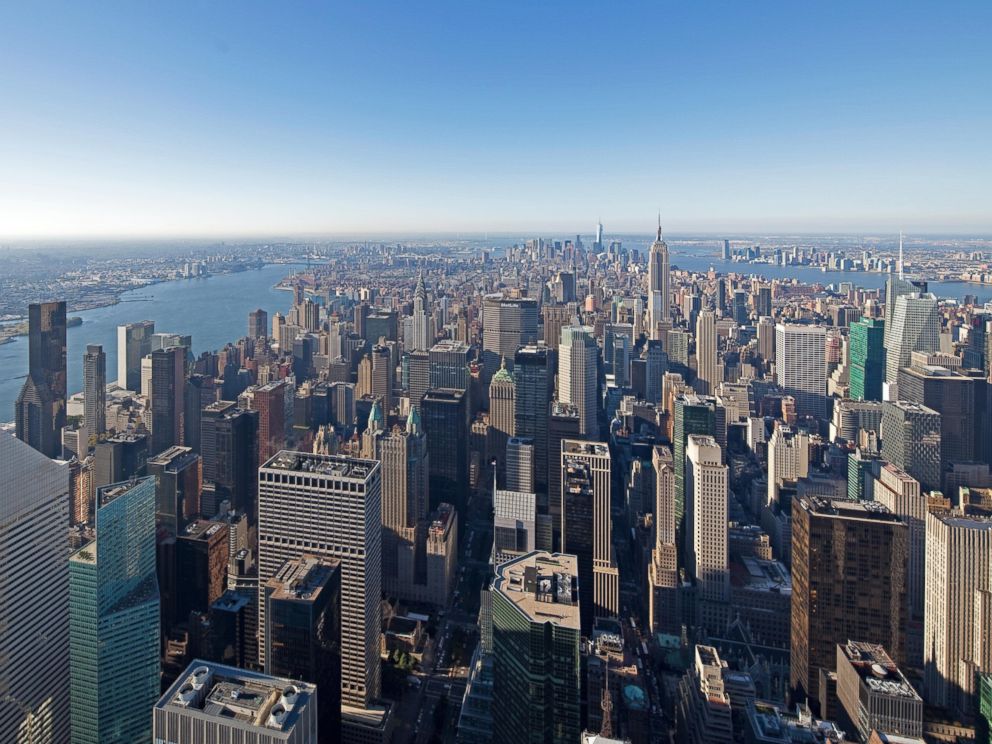
A photo in that ABC News story attracted our personal interest. See the specific image at http://a.abcnews.go.com/images/Technology/HT_tallest_residential_building_4_sk_141014_4x3_992.jpg.

That image was taken -- we assume by ABC News -- from 432 Park Avenue looking southward toward the MetLife Building (formerly the PanAm Building, middle), the Empire State Building (somewhat back and to its right), as well as the One World Trade Center building, the tallest skyscraper (with spire) in the Western Hemisphere, seen far in the distance down in the financial district (e.g. near Wall Street) (see https://en.wikipedia.org/wiki/432_Park_Avenue#/media/File:NYCbyPinHt_update.jpg).

That ABC News image from 432 Park Avenue also includes 345 Park Avenue, a 44-story building which was completed in 1969 and that occupies a whole city block of Midtown Manhattan in what is called the "Plaza District". Compare its base to the "only" 93-foot width on each side at 432 Park Avenue, an architectural difference of generations in the strength of materials and the demands of more limited space in New York City.

By the way, as written at the Wikipedia, the Plaza District is "a term used by Manhattan real estate professionals to denote the most expensive area of midtown from a commercial real estate perspective, lies between 42nd Street and 59th Street, from Third Avenue to Seventh Avenue, about a square kilometer or half a square mile."

At the start of the 1970's, 345 Park Avenue, designed by Emery Roth & Sons, (see Richard Roth Sr.), who also designed the World Trade Center, was just about the tallest and largest building in the neighborhood. It is found in the immediate left foreground in that already cited photo taken from 432 Park Avenue as the widest "bright" rectangular building, standing as if in "T-form" just behind the smaller earlier-built black Seagram Building, whose structure was designed by Mies van der Rohe and with some internal aspects designed by Philip Johnson. The bright color of 345 Park Avenue was intended by design to contrast the neighboring Seagram Building.

345 Park Avenue was the former headquarters of the international law firm Paul, Weiss, Rifkind, Wharton and Garrison ("Paul, Weiss et al." viz. "Paul|Weiss"), where the LawPundit was an associate in the early 1970's. This was once also "my residential neighborhood", so it is always a thrill to follow its development.

In the illustration below, we have marked the approximate location of our former office in that building with reference to that ABC News photo.


Now compare that illustration to the photo at the link ... ABC News photo. To be able to see one's former offices that clearly from high above via the tallest residential building in the Western Hemisphere gives one a special feeling.

A marvelous photo looking southward is also found at 432ParkAvenue.com (click on the photo for a larger image), compressing the distance and thus showing some of the distant buildings better and seemingly closer.

Google Street View takes you to
51st and Park Avenue in New York City,
the location of 345 Park Avenue,
from which there is a view of 432 Park Avenue in 2015.

345 Park Avenue is also known as the Bristol-Myers Squibb Building. It is currently 100% leased and includes the following tenants, according to its website as of our last visit of that website on March 20, 2016:
Hat tip to CaryGEE.


Please note: This posting was made mostly for the interest of our friends and for those interested in New York City architecture especially. Nothing in this posting constitutes paid or unpaid advertising of any kind and it is not a solicitation for anyone to buy or lease apartments or office space, to attend sports gatherings, to invest money or to avail of financial services, to conduct banking transactions, or to wine and dine. We waive any and all liability for anyone relying in any way upon our text or graphic materials or links.


Most Popular Posts of All Time

Sky Earth Native America


Sky Earth Native America 1:
American Indian Rock Art Petroglyphs Pictographs
Cave Paintings Earthworks & Mounds as Land Survey & Astronomy
,
Volume 1, Edition 2, 266 pages, by Andis Kaulins.

  • Sky Earth Native America 2:
    American Indian Rock Art Petroglyphs Pictographs
    Cave Paintings Earthworks & Mounds as Land Survey & Astronomy
    ,
    Volume 2, Edition 2, 262 pages, by Andis Kaulins.

  • Both volumes have the same cover except for the labels "Volume 1" viz. "Volume 2".
    The image on the cover was created using public domain space photos of Earth from NASA.

    -----

    Both book volumes contain the following basic book description:
    "Alice Cunningham Fletcher observed in her 1902 publication in the American Anthropologist
    that there is ample evidence that some ancient cultures in Native America, e.g. the Pawnee in Nebraska,
    geographically located their villages according to patterns seen in stars of the heavens.
    See Alice C. Fletcher, Star Cult Among the Pawnee--A Preliminary Report,
    American Anthropologist, 4, 730-736, 1902.
    Ralph N. Buckstaff wrote:
    "These Indians recognized the constellations as we do, also the important stars,
    drawing them according to their magnitude.
    The groups were placed with a great deal of thought and care and show long study.
    ... They were keen observers....
    The Pawnee Indians must have had a knowledge of astronomy comparable to that of the early white men."
    See Ralph N. Buckstaff, Stars and Constellations of a Pawnee Sky Map,
    American Anthropologist, Vol. 29, Nr. 2, April-June 1927, pp. 279-285, 1927.
    In our book, we take these observations one level further
    and show that megalithic sites and petroglyphic rock carving and pictographic rock art in Native America,
    together with mounds and earthworks, were made to represent territorial geographic landmarks
    placed according to the stars of the sky using the ready map of the starry sky
    in the hermetic tradition, "as above, so below".
    That mirror image of the heavens on terrestrial land is the "Sky Earth" of Native America,
    whose "rock stars" are the real stars of the heavens, "immortalized" by rock art petroglyphs, pictographs,
    cave paintings, earthworks and mounds of various kinds (stone, earth, shells) on our Earth.
    These landmarks were placed systematically in North America, Central America (Meso-America) and South America
    and can to a large degree be reconstructed as the Sky Earth of Native America."


    Our Blogs and Websites

    • 99 is not 100 • Aabecis • AK Photo Blog • Ancient Egypt Weblog • Ancient World Blog • AndisKaulins.com • Andis Kaulins Blog • Archaeology Travel Photos (Flickr) • Archaeology Websearch • Archaeo Pundit • Arts Pundit • Astrology and Birth • Baltic Coachman • Biotechnology Pundit • Book Pundit • Chronology of the Ancient World • Easter Island Script • Echolat • edu.edu • Einstein’s Voice • Etruscan Bronze Liver of Piacenza • EU Pundit • Gadget Pundit • Garden Pundit • Golf Pundit • Gourmet Pundit • Hand Proof • House Pundit • Human Migrations • Idea Pundit • Illyrian Language • Indus Valley Script • Infinity One : The Secret of the First Disk (the game) • Isandis (blogspot) • Journal Pundit • Kaulins Genealogy Blog • Kaulinsium • Latvian Blog • LawPundit.com • LawPundit (blog I) • Law Pundit (blog II) • LexiLine.com • Lexiline Journal • LexiLine (ProBoards) • Library Pundit • Lingwhizt • Literary Pundit • Magnifichess • Make it Music • Maps and Cartography • Megalithic World • Megaliths • Megaliths.net • Minoan Culture • Mutatis Mutandis • Nanotech Pundit • Nostratic Languages • Phaistos Disc • Pharaonic Hieroglyphs • Photo Blog of the World • Prehistoric Art Pundit • Private Wealth Blog • PunditMania • Quanticalian • Quick to Travel • Quill Pundit • Road Pundit • Sport Pundit • Star Pundit • • Stars Stones and Scholars (blog) • Stars Stones and Scholars (book) • Stonehenge Pundit • The Enchanted Glass • UbiquitousPundit • WatchPundit • Wine Pundit • Word Pundit •